Sunday, September 11, 2011

What CAN'T computers do?

Not too long ago, there was a relatively long list of things machines couldn't do by themselves: play chess, read legal briefs, translate poetry, vacuum floors, drive cars, etc. But that list is getting shorter and shorter every year. The latest casualty may be writing newspaper articles.

Kris Hammond and Larry Birnbaum at Northwestern's Intelligent Information Laboratory have started a company called Narrative Science which does just that. Here's a sample, produced with 60 seconds of the end of the third quarter of a recent football game:

“WISCONSIN appears to be in the driver’s seat en route to a win, as it leads 51-10 after the third quarter. Wisconsin added to its lead when Russell Wilson found Jacob Pedersen for an eight-yard touchdown to make the score 44-3 ... . ”

According to Steve Lohr, in the New York Times:

The Narrative Science software can make inferences based on the historical data it collects and the sequence and outcomes of past games. To generate story “angles,” explains Mr. Hammond of Narrative Science, the software learns concepts for articles like “individual effort,” “team effort,” “come from behind,” “back and forth,” “season high,” “player’s streak” and “rankings for team.” Then the software decides what element is most important for that game, and it becomes the lead of the article, he said. The data also determines vocabulary selection. A lopsided score may well be termed a “rout” rather than a “win.”

He ends his article with a prediction by Dr. Hammond:

“In five years,” he says, “a computer program will win a Pulitzer Prize — and I’ll be damned if it’s not our technology.”

That may be a bit ambitious, but one nearly-certain prediction is that computer power will increase by roughly 10-fold in the next five years, and by 100-fold within a decade.

You can also be sure that journalism won't be the only job affected.

Wednesday, August 24, 2011

Steve Jobs Tells Three Stories about his Life


Thanks, Steve, for all you've done for the world. You've been living a life true to your ideals

Monday, August 22, 2011

Good Taxes and Bad Taxes

Congress is considering increasing payroll taxes.

Congress is also considering cutting gasoline taxes.

The net effect is that we would tax work and employment more, while taxing congestion and pollution less.

This is the opposite of what most economists recommend. Arthur Pigou showed that we should tax things we want to reduce, not things we want to increase. What's more, increasing taxes on employment in the midst of the biggest slump since the 1930s is especially foolish.

Perhaps if enough citizens contact Congress, they will do the right thing.


Saturday, June 25, 2011

Can Digital Technologies Replace Superstars?

Japan's newest pop star, Aimi Eguchi, is a digital creation.


For the past couple of decades, digital technologies have been responsible for skill biased technical change, automating and replacing routine, low-skill work while augmenting the demand for more skilled workers. Bank tellers, clerks and assembly line workers were early targets of automation, while rock stars and CEOs benefited from being able to scale their efforts.

The incomes of superstars have skyrocketed while median wages have stagnated.


However, there's nothing inevitable about technologies only being used to replace low-wage work. Pop stars, actors, artists, writers, mathematicians, chess grandmasters have all been targets of automation. In many ways, expert knowledge is easier to codify than common sense. In principle, every profession is potentially vulnerable as digital technologies, robotics and artificial intelligence advance.

There will be increasing disruption in the economy as businesses restructure, and employment, wages, and incomes re-align to the new reality.

Which sectors do you think will be most affected in the next 10 years. Which professions, other than b-school professors, are relatively immune for the time being?

Wednesday, May 11, 2011

Google is putting the "auto" into automobile.


If the last big revolution was replacing muscle power with machines, the next one is automating and augmenting more mental tasks. Henry Ford and compatriots replaced the horse, now Google is working to replace the driver.

According to John Markoff in the New York Times, their self-driving cars have now logged over 140,000 miles on California roads, including highway 1 between L.A. and San Francisco. They are now lobbying Nevada to allow these cars on public roads.

The project leader, Dr. Sebastian Thrun has argued that robotic vehicles would increase energy efficiency, reduce road injuries and deaths, and cut the number of cars needed in the United States in half.

“What if I could take out my phone and say, ‘Zipcar, come here,’ ” he asked an industry conference last year, “and a moment later the Zipcar came around the


I suspect the biggest barrier to the adoption of self-driving cars is not technological -- these videos show how the systems are rapidly progressing. Instead, the impediments will be regulatory and cultural. There are about 40,000 deaths on the America's roads each year with our human drivers. But suppose the robotic cars were 100 times safer. That would still be 400 deaths per year. Can you imagine the public outcry, no to mention the legal judgments, that would follow the first time a human was killed due to an error by a robotic car? Will they have to be 100% perfect before the are adopted?

Monday, May 9, 2011

Business class vs. Economy online news

Newspapers like the New York Times and Wall Street Journal are currently experimenting with paywalls that prevent non-paying customers from accessing some content. But what if all customers could access the same content, but the "economy" (i.e. free) visitors saw ads and other clutter while the "business class" customers got a cleaner experience? Would that be a viable model?

Oliver Reichenstein argues that it could be, and gives the example of the two pages below. Would you pay a premium to read the one on the right? What else could a publisher do to create premium experience for paying customers, other than restricting content?


Wednesday, May 4, 2011

Inequality is growing around the world

A new OECD reports concludes that "inequality is on the rise in most OECD countries" and that:

In a large majority of OECD countries, household incomes of the top 10% grew faster than those of the poorest 10%, leading to widening income inequality. Differences in the pace of income growth across household groups were particularly pronounced in some of the English-speaking countries, some of the Nordic countries and Israel. In Israel and Japan, real incomes of people at the bottom of the income ladder actually have fallen since the mid-1980s.


As The Economist summarizes that data as follows:

American society is more unequal than those in most other OECD countries, and growth in inequality there has been relatively large. But with very few exceptions, the rich have done better over the past 30 years, even in highly egalitarian places like Scandinavia.


Technology and globalization are likely the primary causes of the recent changes, although the institutions, culture and government policies can also make a difference.

Here's a chart from the Economist, HT: Greg Mankiw


Sunday, April 10, 2011

How'd we get all that debt?

The New York Times has an interesting article on the U.S government debt, which is now approaching $14.2 trillion. Of course, most of it is owed to ourselves, via Social Security and treasury securities held by Americans. It's interesting to understand the policies that led us to incur that debt.


.

Sunday, April 3, 2011

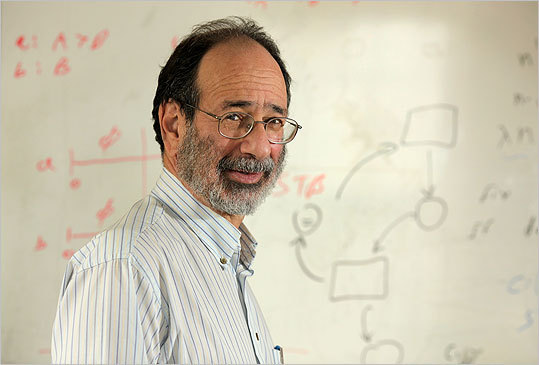
Al Roth, Market Designer


Al Roth has been doing fascinating work designing matching markets. These include the markets for matching kidney donors and recipients, medical residents to programs, and assigning students to schools.

In these markets, small changes in the "rules of the game" can lead to big efficiency gains, and it's not always obvious how to best make those changes. That's where the kind of deep theory that Al does can have practical value.

Today, the Boston Globe has a nice profile of Al and his work:

[R]ecently, he and one of his students have been talking with Teach for America about improving the system it uses to deploy volunteers around the country.

Inspired by Roth’s work, these rising economists are also setting their sights on real-world problems. Some are looking at dating websites; others are interested in how universities could do better at scheduling their students’ classes. Like Roth, all of them envision a world in which economists, as unlikely as it may seem, are recognized as society’s mechanics.


As more of the value of the economy moves from the manipulation of physical objects to the design of institutions, the work of "mechanics" like Al will become more important. While it is common to view theory and practice as polar opposites, this work is a good example of how the synergies they can create when combined. It's also underscores that the "invisible hand" of the market can often benefit from some intelligent design by humans.

Tuesday, March 8, 2011

Stagnation or Mismeasurement?

A long, long time ago, in an office not far away, I did some work on the "Productivity Paradox".

Recently, the issue has resurfaced in a new way, especially via a new e-book by Tyler Cowen called "The Great Stagnation".

Annie Lowrey in Slate discusses Tyler's thesis and quotes me on one counter argument:

But revenue is not always the end-all, be-all—even in economics. That brings us to a final explanation: Maybe it is not the growth that is deficient. Maybe it is the yardstick that is deficient. MIT professor Erik Brynjolffson explains the idea using the example of the music industry. "Because you and I stopped buying CDs, the music industry has shrunk, according to revenues and GDP. But we're not listening to less music. There's more music consumed than before." The improved choice and variety and availability of music must be worth something to us—even if it is not easy to put into numbers. "On paper, the way GDP is calculated, the music industry is disappearing, but in reality it's not disappearing. It is disappearing in revenue. It is not disappearing in terms of what you should care about, which is music."

Here are two papers where I discuss this idea in more detail.

What the GDP gets wrong in Sloan Management Review.

Consumer Surplus in the Digital Economy in Management Science.

Not only are they free, but they also spell my name correctly. However, I can make no promises that you'll get any more consumer value than you pay for them.